


20 Jul Minimum Usage Charges on Copiers and Printers: Are You Paying for Prints You Never Use?
Minimum Usage Charges on Copiers and Printers Explained
Minimum usage charges can cause businesses to pay for thousands of copier or printer pages they never actually produce. This guide explains how these charges work, where to find them and how to calculate the true cost of your current print agreement.
Copier contracts can be confusing because equipment rental, maintenance and copy charges are often separated across different agreements and invoices. A low advertised cost per copy may look attractive, but it does not always show what your organisation will really pay.
What Is a Minimum Usage Charge?
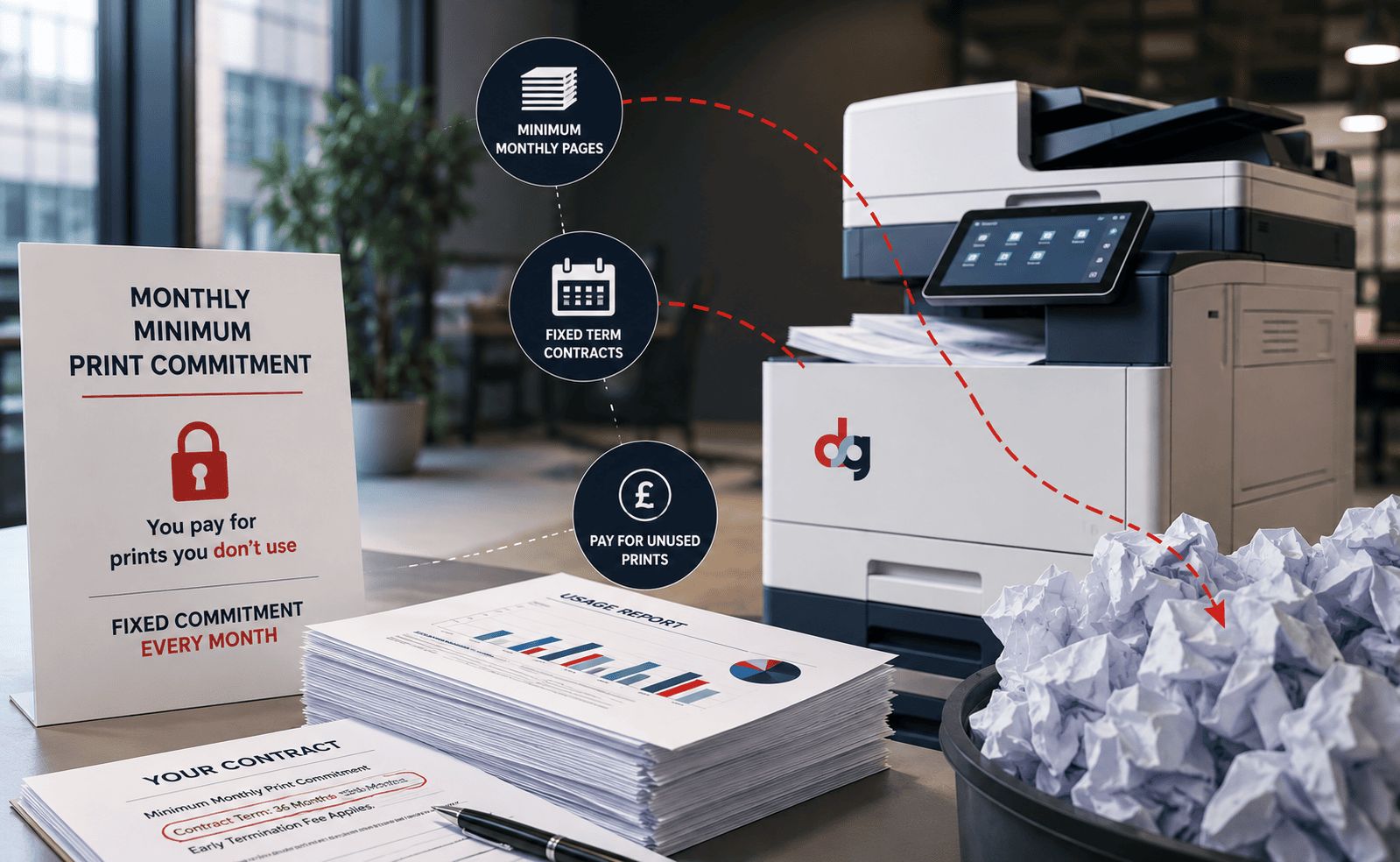
A minimum usage charge is a contractual commitment requiring a business to pay for a fixed quantity of copier or printer pages during each billing period.
The minimum may apply monthly, quarterly or annually. It may be divided into separate black-and-white and colour page commitments.
When actual usage is lower than the agreed minimum, the supplier may still invoice the customer for the full committed volume.
In practice, this means your business can pay for prints and copies that were never produced.
Simple example
Your service agreement includes a quarterly minimum of 15,000 black-and-white pages.
Your copier only produces 9,000 black-and-white pages during that quarter.
The supplier may still invoice you for 15,000 pages, meaning you pay for 6,000 unused pages.
How Do Minimum Copier Charges Work?
Although the terminology varies between suppliers, most minimum billing arrangements follow the same general structure.
1. A Minimum Volume Is Agreed
The service agreement specifies a minimum quantity of black-and-white or colour pages for each billing period.
This figure may be based on estimated usage, historic meter readings or a volume suggested during the sales process.
2. The Minimum Is Invoiced
The customer pays for the agreed minimum even when the device records fewer pages.
Some suppliers show this as a fixed service charge, while others show the committed page quantity on the invoice.
3. Excess Usage Is Added
When actual usage exceeds the minimum, additional pages are charged at the agreed excess cost-per-copy rate.
The customer therefore carries the downside of low usage while still paying extra when usage rises.
Minimum Usage Versus Pay-As-You-Print
The main difference is whether your invoice is based on a contractual minimum or the meter readings recorded by the device.
| Consideration | Minimum Usage Agreement | Pay-As-You-Print Agreement |
|---|---|---|
| Billing basis | Committed minimum page quantity | Pages actually produced |
| When usage falls | Charges may remain unchanged | Page charges reduce with usage |
| Unused pages | May still be invoiced | Not charged |
| Seasonal demand | Quiet periods may still attract the full minimum | Billing follows actual seasonal demand |
| Invoice transparency | Charges may not match actual meter movement | Charges can be checked against meter readings |
| Flexibility | Customer remains tied to historic volume assumptions | Costs adapt as the organisation changes |
Worked Example: How Much Can Minimum Usage Cost?
The following simplified example shows how a minimum commitment can increase the real cost of printing.
| Item | Minimum Usage Agreement | Actual Usage Agreement |
|---|---|---|
| Minimum black-and-white pages | 15,000 per quarter | No minimum |
| Actual black-and-white usage | 9,000 pages | 9,000 pages |
| Contracted rate | 0.6p per page | 0.6p per page |
| Quarterly service charge | £90.00 | £54.00 |
| Cost of unused pages | £36.00 | £0.00 |
| Annual unused-page cost | £144.00 | £0.00 |
This example only covers one black-and-white commitment. The total impact can be greater when agreements include several devices, separate colour minimums, annual price increases or long contract terms.
Where Can You Find a Minimum Usage Charge?
Minimum copy commitments are not always shown on the equipment finance agreement.
Copier contracts commonly have two separate elements: the equipment rental and the service or maintenance agreement.
The minimum usage charge is usually found within the service agreement, maintenance agreement, cost-per-copy schedule or recurring service invoice.
It is important to review every document rather than relying only on the headline rental figure.
Look for terms such as:
- Minimum billing volume
- Minimum copy charge
- Quarterly minimum
- Minimum service commitment
- Committed volume
- Inclusive copy allowance
- Minimum meter charge
- Minimum impression volume
- Base service charge
- Copies included per quarter
The equipment lease and service contract are different
The lease or rental usually pays for the copier itself.
The service agreement normally covers toner, maintenance, replacement parts, engineer support and ongoing photocopier servicing, repairs and maintenance.
A low monthly rental does not necessarily mean the total copier arrangement is good value.
Copier Rental Versus Service Charges
Businesses often compare copier proposals using the monthly rental alone. This can hide substantial differences in service charges and usage commitments.
One supplier may advertise a lower rental while applying higher colour rates, standing charges, minimum billing or frequent annual increases.
A fair comparison should include equipment rental, black-and-white usage, colour usage, minimum commitments, additional charges and the full contract term.
Why Do Businesses Pay for Unused Prints?
Minimum volumes are normally agreed when the contract begins, but business printing can change considerably during a three-year or five-year agreement.
Hybrid Working
Fewer employees attending the office every day can reduce document production significantly.
Digital Workflows
Electronic signatures, cloud document storage and online forms reduce the need for physical copies.
Employee Changes
A smaller workforce or departmental restructure can make historic print estimates inaccurate.
Seasonal Demand
Schools, charities, hospitality businesses and seasonal companies may experience extended low-usage periods.
Device Consolidation
Removing users or moving work to another site can leave individual devices below their minimum commitment.
Changing Customer Behaviour
Customers and suppliers increasingly accept digital invoices, statements, forms and contracts.
How Can You Tell Whether You Are Paying a Minimum?
Start by comparing the page quantities shown on your invoices with the meter readings from the copier.
If your service invoice repeatedly shows the same quantity despite changing meter usage, a minimum commitment may be applied.
You should also compare several billing periods rather than relying on a single invoice.
Automatic meter systems normally record separate totals for black-and-white and colour pages, making these comparisons easier.
Documents to collect
- Equipment rental or lease agreement
- Service and maintenance agreement
- Cost-per-copy schedule
- Three to six recent service invoices
- Current copier meter readings
- Contract start and end dates
- Annual price increase notices
- Device make, model and location
The headline page rate may not be your real page cost
A contracted rate of 0.6p per black-and-white page only represents the true cost when the invoice is based on actual usage.
When unused minimum pages are included, the effective cost of each page actually produced becomes higher.
How to Calculate Your True Cost Per Copy
To calculate the effective cost per page, divide the total service charge by the number of pages actually printed during the same period.
For example, if you pay £90 for 9,000 actual black-and-white pages, your true cost is 1p per page, even if the contracted rate is shown as 0.6p.
Other Copier Charges to Check
Minimum usage is only one area that can affect the total cost of a copier or printer contract.
Annual Price Increases
Check whether copy rates, service charges or both can increase each year.
Standing Charges
Some agreements include fixed service charges in addition to page usage.
Delivery Charges
Toner or consumable delivery may attract separate fees under some agreements.
Excluded Parts
Certain consumables, drums or components may not be included within the standard service rate.
Meter Estimates
Estimated readings can create inaccurate billing if they are not corrected promptly.
Early Settlement
Replacing equipment before the agreement ends may require the remaining finance to be settled.
Automatic Renewal
Check whether the service agreement renews unless notice is provided by a specified date.
Collection or Return Fees
Equipment return requirements and end-of-contract charges should be confirmed in advance.
Questions to Ask Before Signing a Copier Agreement
Is There a Minimum Commitment?
Ask whether you will pay for an agreed quantity when your actual meter usage is lower.
What Is Included in the Copy Rate?
Confirm whether toner, replacement parts, engineer callouts and photocopier maintenance and repair support are included.
How Are Meter Readings Collected?
Automatic readings generally provide better billing accuracy than estimates or manual submissions.
How Can Prices Increase?
Ask how often service rates can increase and whether any maximum increase is defined.
Do the Agreements End Together?
Confirm whether the equipment lease and service agreement have matching end dates.
What Happens at Contract End?
Review notice periods, automatic renewal, equipment return and potential settlement charges.
Can a Minimum Usage Charge Be Removed?
Whether a minimum commitment can be removed depends on the wording of the existing agreement and the willingness of the supplier to amend it.
Some suppliers may agree to reduce the minimum where business usage has changed significantly, particularly when the customer is approaching renewal.
During a live fixed-term agreement, the supplier may argue that the minimum forms part of the original commercial arrangement.
The most effective starting point is to establish the true financial impact and request a written review based on current meter data.
Review both agreements before changing supplier
The equipment lease and service contract may have different providers, terms and end dates.
Cancelling or replacing one agreement does not automatically end the other.
Always confirm outstanding finance and notice requirements before agreeing to replacement equipment.
A clear service agreement can include:
- No minimum page commitment
- Billing based on actual meter usage
- Automatic toner replenishment
- Engineer callouts
- Replacement parts and labour
- Preventative maintenance
- Remote meter collection
- Technical support
- Clear black-and-white and colour rates
- Defined contract and renewal terms
Digital Office Group's Pay-for-What-You-Use Approach
Digital Office Group's standard cost-per-copy service arrangements do not require customers to commit to a minimum number of prints or copies.
Service billing is based on the actual meter usage recorded by the device. If your print volume falls, the associated copy charges fall as well.
Toner, replacement parts, engineer labour and ongoing photocopier service and maintenance can be included within the agreed page rates, creating a clear and transparent arrangement.
Businesses considering new equipment can explore our wider photocopier and printer solutions or contact our team for a contract review.
Why Review Your Copier Agreement?
A contract review can help separate genuine equipment and service costs from charges linked to historic print assumptions.
It can also identify duplicated devices, unsuitable equipment, excessive colour usage, unsupported machines and opportunities to consolidate suppliers.
For an accurate assessment, compare the complete cost over the remaining contract term rather than only looking at a proposed monthly rental.
A print cost review should examine:
- Monthly or quarterly equipment rental
- Service and maintenance charges
- Minimum black-and-white usage
- Minimum colour usage
- Actual meter volumes
- Effective cost per printed page
- Annual price increases
- Outstanding contract term
- Equipment suitability
- Potential replacement or consolidation options
Minimum Usage Charge FAQs
What is a minimum usage charge on a copier?
A minimum usage charge requires the customer to pay for a fixed number of pages during each billing period, even when the copier produces fewer pages.
Can I be charged for pages I did not print?
Yes. When your agreement contains a minimum volume, the supplier may invoice the full committed quantity regardless of actual usage.
Is minimum usage the same as copier rental?
No. Copier rental normally covers the equipment. Minimum usage normally appears within the separate service or maintenance agreement.
What is a cost-per-copy agreement?
A cost-per-copy agreement charges an agreed rate for each black-and-white or colour page and normally includes toner and equipment maintenance.
Where can I find my minimum commitment?
Review the service agreement, maintenance agreement, cost-per-copy schedule and recent invoices for terms such as minimum billing volume or quarterly minimum.
How do I calculate my real cost per copy?
Divide the total service charge for the billing period by the number of pages actually produced during that same period.
Why has my print usage fallen?
Hybrid working, cloud systems, electronic signatures, changing staffing levels and digital customer communications have reduced print demand for many organisations.
Can minimum charges rise each year?
This depends on the agreement. Some suppliers apply annual increases to service rates, minimum charges or both.
Can I negotiate a lower minimum?
You can ask the supplier to review the commitment using current meter data, although any amendment will depend on the contract and supplier agreement.
Does Digital Office Group apply minimum print charges?
Digital Office Group's standard cost-per-copy service arrangements are based on actual meter usage and do not require a minimum print commitment.
What is included in a copier service agreement?
A copier service agreement can include toner, replacement parts, labour, engineer callouts, technical support, meter collection and ongoing photocopier servicing and maintenance.
Can Digital Office Group review my current agreement?
Yes. We can review your rental agreement, service contract, invoices, meter readings and contract dates and provide a clear cost comparison.
Are You Paying for Prints Your Business Never Uses?
Send Digital Office Group your current copier agreements and recent invoices. We will review your equipment rental, service charges, minimum usage and actual meter volumes and provide a clear, no-obligation cost assessment.
Request a Free Copier Contract Review